
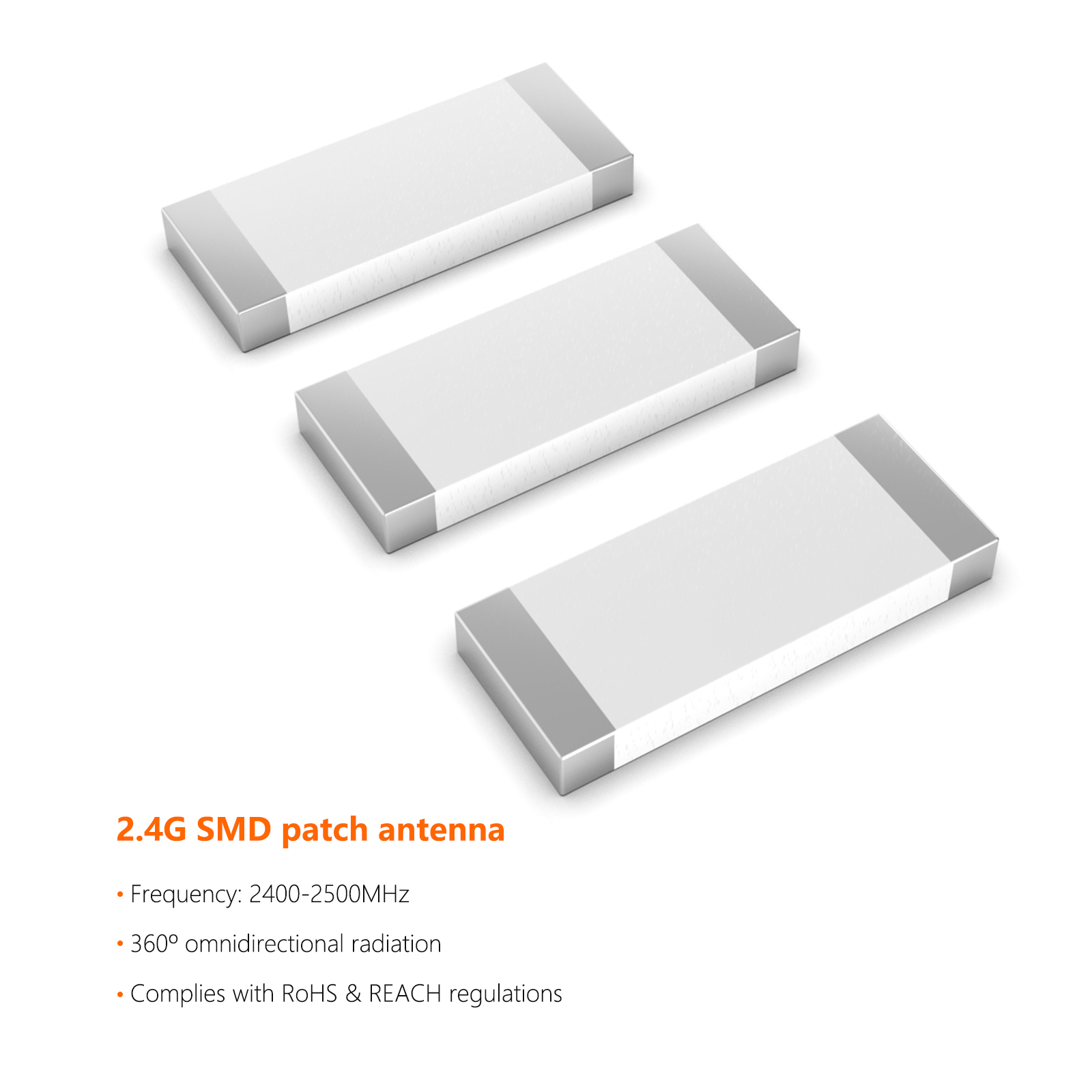
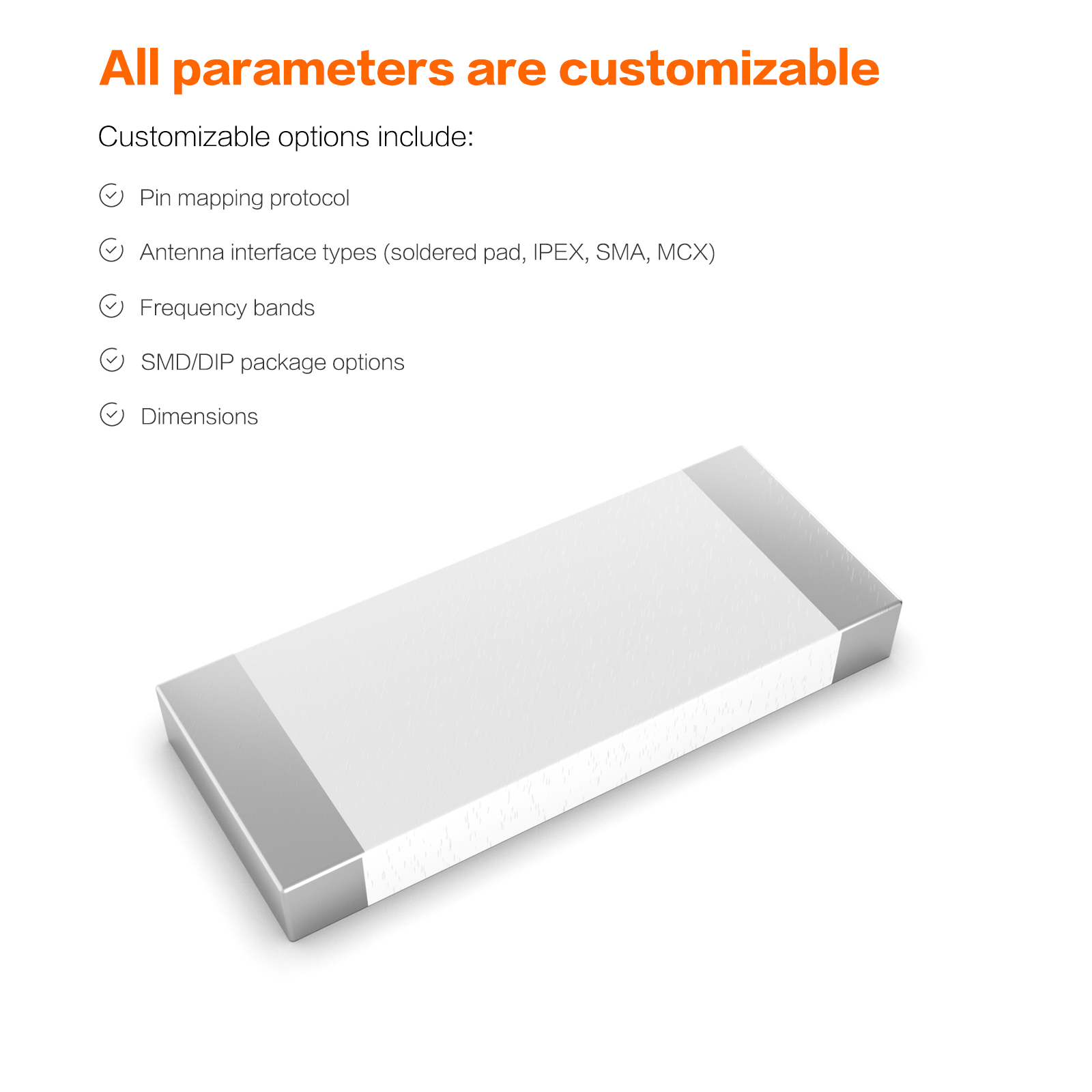
2.4G SMD chip antenna for IoT, smart home, wearable devices and other miniaturized 2.4G scenarios
Model:BF2.4MNS3216
Specification:
- Frequency:2400-2500 mHz
- Size:3.2 x 1.6 x 0.6 mm
About Products
Bat Wireless BF2.4MNS3216is an antenna commonly used in wireless communication. It features high integration for space-saving, with compactness and integration as its key attributes. The patch antenna is directly printed on the SMD, occupying minimal space and making it suitable for compact devices. It offers low cost: utilizing SMD technology for one-time fabrication, it requires no additional antenna components, thus being ideal for mass production. This antenna is suitable for miniaturized devices and widely applied in modules such as IoT, consumer electronics, and
industrial equipment.


Core Product Features: Ultra-Mini Size + High Performance, Adapt to Extreme Miniaturization Scenarios
1. Electrical Characteristics: 2.4G Full-Band Optimization, Low-Loss & Efficient Transmission
- 2.4G Full-Band Coverage: The operating frequency is precisely locked at 2400-2500MHz, perfectly matching mainstream 2.4G wireless technologies such as Wi-Fi (2.4G), Bluetooth, and ZigBee. There is no need to replace antennas due to protocol/device differences, making it a core communication component for "2.4G ecosystem" devices such as IoT, smart homes, and wearable devices.
- Low Return Loss + Efficient Gain: Return Loss is as low as -6.5dB, combined with 50Ω standard input impedance, which minimizes signal reflection and energy waste to the greatest extent. The 1.85dBi gain adopts a vertical polarization design, enabling more balanced vertical signal penetration and coverage in multi-device dense indoor environments (such as smart home scenarios), effectively improving signal reception sensitivity and making data transmission more stable.
- High Power Stable Capacity: With a power capacity of 50W, it can support the stable operation of high-power 2.4G devices (such as industrial wireless data transmission modules, high-bandwidth Wi-Fi terminals). Even when facing concurrent transmission of multiple devices (such as multiple Wi-Fi devices connected to the network simultaneously in an office), it can avoid performance degradation caused by power overload and ensure communication continuity.
2. Mechanical Characteristics: Ultra-Mini SMD Design, Extreme Integration & Easy Production
- Micron-Level Ultra-Small Size: The overall size is only 3.2mm×1.6mm×0.6mm (about the size of a sesame seed), and the weight is only 0.2g (about the weight of a hair). It can be easily integrated into ultra-small devices such as smart watches, micro sensors, and TWS earphones, perfectly adapting to the "extreme miniaturization" design trend of consumer electronics and IoT terminals.
- SMD Mounting + PCB Material: Adopting SMD (Surface Mount Device) technology, it can be directly welded in batches through SMT (Surface Mount Technology) production lines and seamlessly integrated with PCB boards. The main body is made of PCB material, which has excellent electrical performance and structural stability, is not easy to fall off after welding, and is compatible with automated production processes, greatly improving mass production efficiency and yield.
- No Additional Cables/Connectors: There is no need for external cables or connectors, and it is directly integrated on the device PCB board, reducing component space occupation and signal transmission loss, and simplifying the internal wiring design of the device.
3. Environmental Characteristics: Wide Temperature + Environmental Compliance, Reliable Operation in All Scenarios
- Ultra-Wide Temperature Adaptation: The operating temperature range reaches -45~+85℃, enabling stable operation in extreme environments such as extremely cold winters in northern regions (-40℃), hot summers in southern regions (+70℃), and industrial high-temperature workshops (+80℃), without additional temperature control measures, and suitable for multi-scenario deployment such as outdoor monitoring and industrial automation.
- RoHS Compliance for Eco-Friendliness: Strictly RoHS compliant, free of harmful substances such as lead and cadmium. It can be safely used in children's wearable devices, medical monitoring terminals, and consumer electronic products, meeting the environmental and compliance requirements of the global market.
Core Advantages: Focus on "Ultra-Mini, High Integration, Stable Transmission" to Empower Miniaturized Smart Devices
- "Micron-Level Size + SMD Technology" Full Integration: The extreme size of 3.2×1.6×0.6mm + SMD mounting completely solves the industry pain point of "communication antennas occupying space in small devices", especially suitable for products with extremely sensitive space such as smart watches, micro sensors, and TWS earphones.
- "Low Return Loss + High Gain" More Stable Transmission: -6.5dB low return loss reduces signal waste, and 1.85dBi gain improves reception sensitivity. In 2.4G environments with multiple interferences (such as multiple Bluetooth devices at home, dense Wi-Fi scenarios in offices), it can still ensure stable transmission of data (such as health data of wearable devices, monitoring data of sensors), improving the communication reliability of devices.
- "High Power + Wide Temperature Range" Strong Scenario Adaptability: 50W power supports high-load transmission, and the -45~+85℃ wide temperature range covers most climate and industrial scenarios around the world. From polar scientific research equipment to desert monitoring terminals, they can all work stably without additional adaptation.
Multi-Industry Application Scenarios: Covering Core Needs of 2.4G Wireless, Empowering Intelligent Upgrades in All Fields
- Consumer Electronics: Smart Wearables & Micro Devices. Compatible with smart watches, TWS true wireless earphones, micro action cameras and other devices. The ultra-mini size can be hidden and integrated inside the device case/earphone cavity. The 2.4G frequency band supports Bluetooth calls and Wi-Fi networking (such as watch synchronizing mobile phone data). Low return loss ensures that the signal is not interrupted during exercise (such as running, mountain climbing), making the communication of wearable devices more stable and the battery life longer.
- Smart Home: Sensing & Control Terminals. Matched with 2.4G smart home sensors (such as temperature and humidity sensors, human infrared sensors), smart switches and other terminals. The SMD chip is directly welded on the device PCB, saving internal space. Vertical polarization and omnidirectional radiation enable signal coverage in every corner of the home, ensuring real-time upload of sensor data (such as temperature and humidity data transmitted from living room sensors to the gateway) and accurate delivery of switch commands (such as remote control of bedroom lights via mobile phones), enhancing the smart home experience.
- Industrial IoT: Micro Monitoring & Data Transmission Modules. Used in industrial micro vibration sensors, temperature and humidity monitoring nodes and other devices. PCB material resists electromagnetic interference in industrial environments, and the -45~+85℃ wide temperature adapts to temperature changes in workshops. 50W power supports high-bandwidth data transmission (such as real-time backhaul of equipment vibration data). SMD technology is compatible with batch production in industrial automated production lines, helping factory equipment condition monitoring and predictive maintenance.
- Medical Health: Portable Monitoring Devices. Compatible with portable ECG monitors, blood glucose detectors and other medical terminals. The ultra-small size can be embedded in the device case without affecting portability. RoHS compliance ensures safety in contact with the human body. The 2.4G frequency band supports the device to transmit health data (such as ECG waveforms, blood glucose values) to mobile phones/medical cloud platforms. Low return loss enables data transmission without delay, assisting doctors in real-time diagnosis.
- Outdoor IoT: Environmental & Security Sensing. Matched with outdoor micro environmental monitoring sensors (such as atmospheric pressure sensors, light sensors), security infrared detectors. The wide temperature range adapts to extreme outdoor weather (such as -30℃ in mountains, +60℃ in deserts). Omnidirectional radiation ensures that sensors can stably transmit environmental data back to the 2.4G gateway in the wilderness, providing reliable data support for meteorological research and scenic spot security.


