
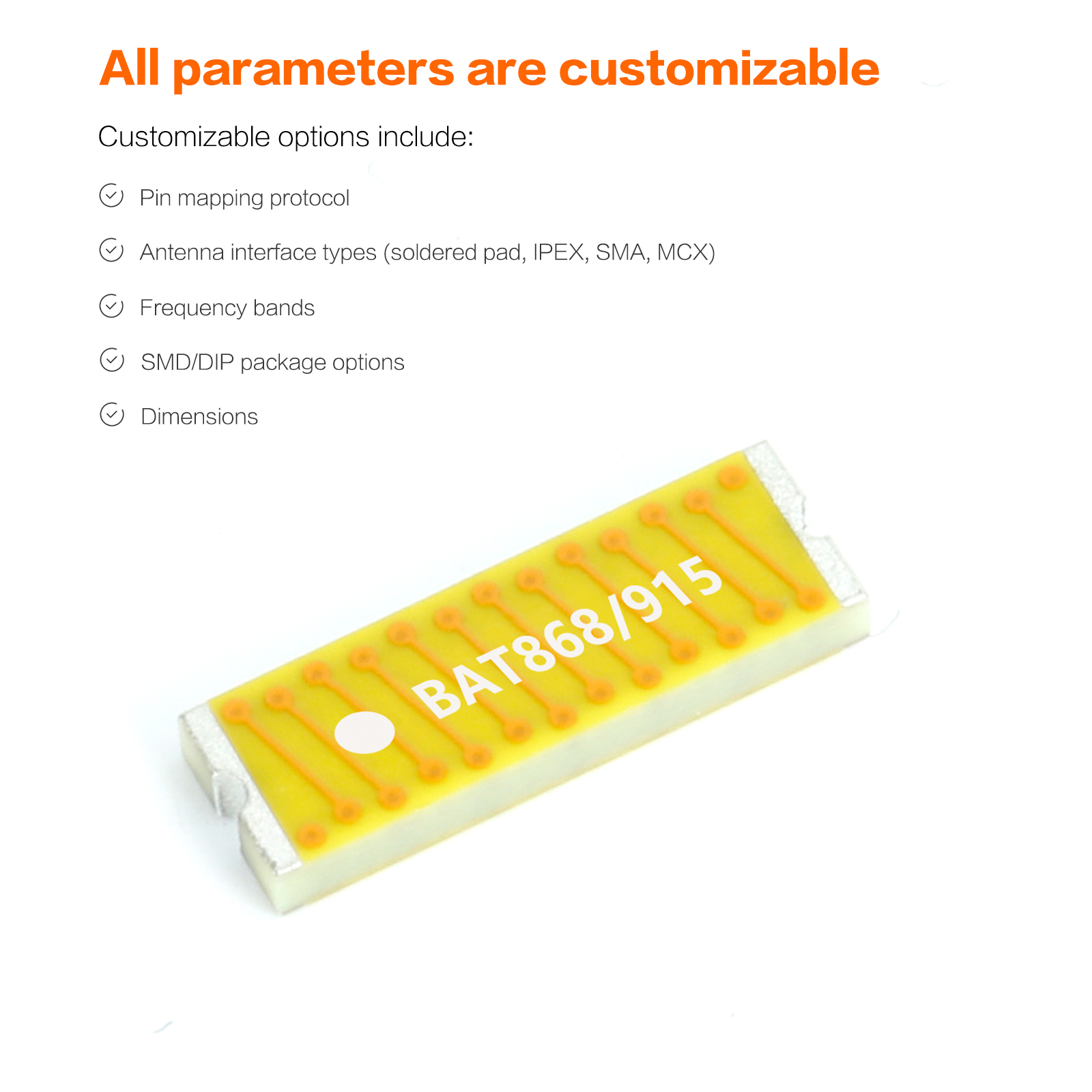
915MHz SMD chip antenna for North American LoRa IoT, industrial data transmission, smart monitoring
Model:BF915MNX1304
Specification:
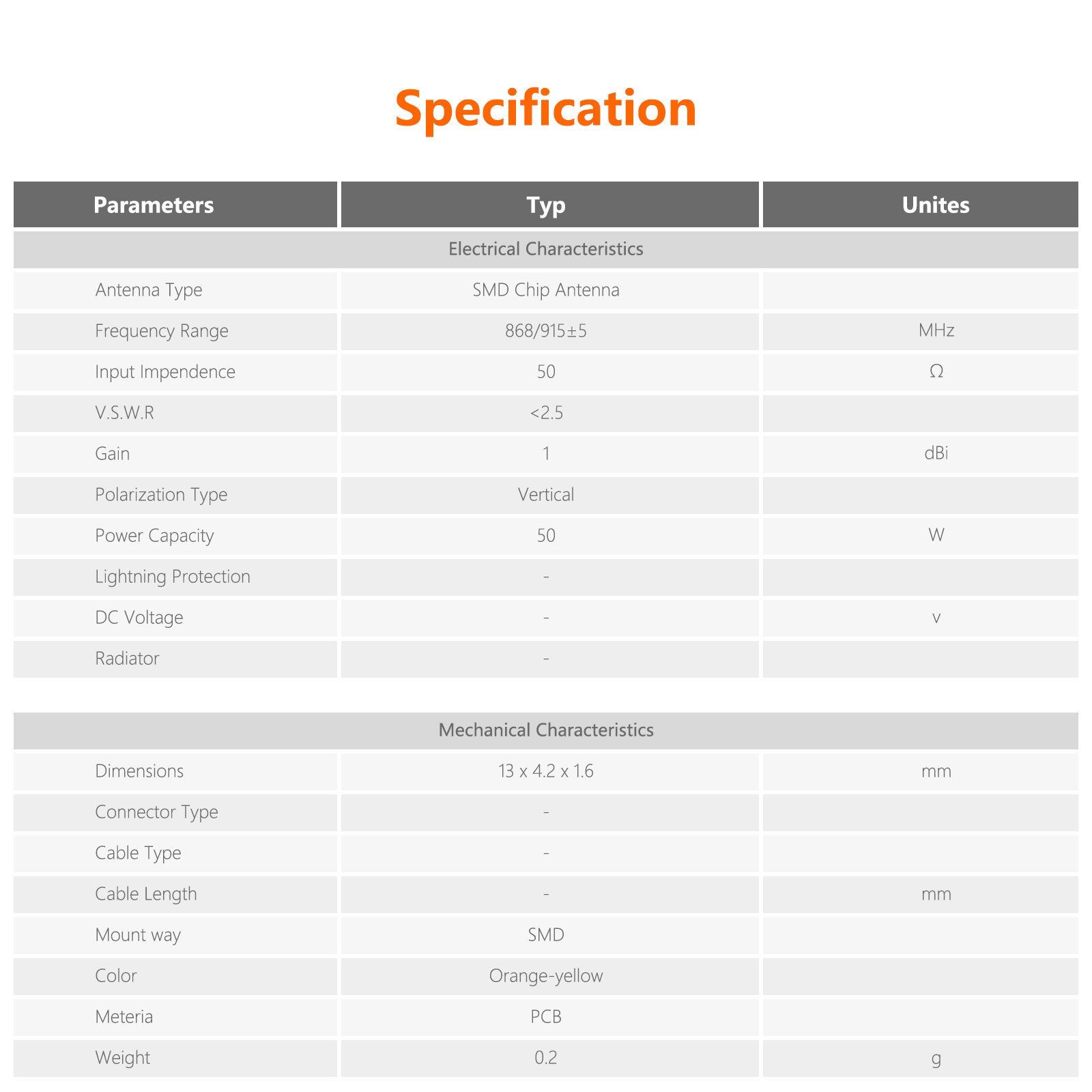
- Frequency:915±5 MHz
- Size:13 x 4.2 x 1.6 mm
About Products


Core Product Features: North American 915MHz Frequency Optimization, Orange-Yellow Marking for North American Production Lines
1. Electrical Characteristics: North American LoRa Core Band, Stable and Efficient Transmission
- 915±5MHz Core North American LoRaWAN Band: Operating frequency is precisely locked at 915±5MHz, the core licensed band for North American LoRaWAN (Low Power Wide Area Network), perfectly suitable for IoT, smart meters, and industrial sensing scenarios in the US and Canada. It can directly connect to North American LoRaWAN operator networks (e.g., Helium, Semtech ecosystem) without frequency adjustment, enabling "plug-and-play" market access in North America.
- Low VSWR + Omnidirectional Gain Ensure Communication Stability: Voltage Standing Wave Ratio (V.S.W.R) is <2.5, combined with 50Ω standard input impedance to significantly reduce signal reflection loss; 1dBi gain with vertical polarization supports 360° omnidirectional radiation. In North American urban multi-building and multi-interference environments, it has excellent wall-penetrating capability and uniform coverage, ensuring long-distance stable communication between LoRa nodes (e.g., smart meters, environmental sensors) and gateways.
- High Power Capacity for Dense Networking: With a power capacity of 50W, it supports stable operation of industrial-grade LoRa data transmission modules and high-power gateways. Even in the face of dense IoT node networking in North America (e.g., hundreds of smart water meters in a city transmitting data simultaneously), it can avoid communication interruptions caused by power overload, ensuring data transmission continuity.
2. Mechanical Characteristics: SMD Mounting + Orange-Yellow Marking, Efficient Mass Production in North America
- Ultra-Compact SMD Integration for North American Miniaturized Terminals: Dimensions are only 13mm×4.2mm×1.6mm, weight 0.2g, adopting SMD (Surface Mount Device) technology, which can be directly welded in batches via North American SMT production lines and seamlessly integrated with device PCB boards. It perfectly adapts to the "miniaturization and high integration" design trend of North American IoT terminals (e.g., micro LoRa sensors, smart gas meters), greatly saving internal space of terminals.
- Orange-Yellow PCB Enhance North American Production Line Recognition: The main body is made of orange-yellow PCB, which has extremely high visual recognition in North American automated production lines, facilitating quick identification and welding by equipment and reducing production misjudgment rates. The PCB material also has excellent electrical performance and structural stability, not easy to fall off after welding, and is compatible with North American large-scale automated production processes, significantly improving mass production efficiency and yield.
- No External Design Simplifies Terminal Wiring: Directly integrated on the device PCB, no additional cables or connectors are required, reducing component space occupation and signal transmission loss, and simplifying the internal design of terminals, which meets the "concise and reliable" design requirements of North American terminal products.
3. Environmental Characteristics: Wide Temperature Range + Dual Compliance, Adapt to All North American Scenarios
- Ultra-Wide Temperature Range for Diverse North American Climates: Operating and storage temperature ranges are -45~+85℃, which can work stably in North American extremely cold winters (e.g., Canada -30℃), hot summers (e.g., US desert +50℃), and industrial high-temperature workshops without additional temperature control measures. It is suitable for multi-scenario deployment such as North American outdoor IoT nodes (e.g., smart street lamp sensors) and industrial automation equipment.
- Dual Compliance with RoHS & REACH Break North American Trade Barriers: Strictly complies with North American RoHS and REACH regulations, free of harmful substances such as lead and cadmium, meeting the environmental access requirements of North American consumer electronics and industrial equipment, and eliminating trade compliance barriers in the North American market, helping products enter the North American market quickly.
Core Advantages: Focus on "North American Compliance, Easy Mass Production, Multi-Scenarios" to Empower North American IoT Ecosystem
- "North American 915MHz Dedicated Band" Precise Match with North American Market Demands: Deeply optimized for the North American LoRaWAN frequency band, a single antenna can match core North American scenarios such as smart meters, industrial sensing, and urban IoT, reducing inventory costs for North American customers, especially suitable for large-scale projects of North American IoT solution providers (e.g., Helium, Semtech partners), realizing efficient resource utilization of "one frequency for multiple scenarios".
- "SMD Mounting + Orange-Yellow Marking" North American Production Line-Friendly Design: SMD technology is compatible with North American automated production lines, and the orange-yellow material improves recognition efficiency in North American production lines, shortening the production cycle; the compact size can be embedded into various North American micro terminals, solving the industry pain point of "difficult antenna integration in miniaturized North American devices" and accelerating product mass production.
- "Wide Temperature Range + Dual Compliance" Full-Scenario Coverage in North American Market: The -45~+85℃ wide temperature range adapts to diverse North American climates from Canada to the southern US, and RoHS/REACH compliance meets North American strict environmental requirements. It can work stably from polar scientific research equipment to desert environmental sensing, from consumer electronics to industrial equipment, expanding product application boundaries.


Multi-Industry Application Scenarios: Covering Core Needs of 915MHz Wireless in North America for Intelligent Upgrades
- North American Smart Meters: Remote Meter Reading and Energy Efficiency Management for Water, Electricity, and Gas. Compatible with North American 915MHz smart electricity meters, gas meters, and water meters, SMD mounting makes the meters more compact, and 1dBi omnidirectional gain ensures stable data backhaul in North American multi-building environments; the wide temperature range supports long-term operation in Canada -30℃ extremely cold environments, helping the digital transformation of North American energy and realizing remote meter reading, abnormal flow warning, and energy efficiency management.
- North American Industrial IoT: Predictive Maintenance and Production Line Intelligence. Matched with 915MHz industrial sensors (e.g., vibration sensors, temperature and humidity sensors), it occupies no space after being embedded into the device PCB (13mm size); vertical polarization and omnidirectional radiation enable stable signal backhaul to the gateway in complex North American factory layouts, helping predictive maintenance of US manufacturing and real-time monitoring of Canadian industrial production environments, reducing equipment downtime risks.
- North American Smart Cities: Intelligent Management of Environment and Public Facilities. In North American smart city systems, it serves as a 915MHz environmental sensor antenna (e.g., air quality, traffic flow sensors), and SMD mounting can be hidden and integrated at the edge of street lamps and buildings; the 915MHz frequency band avoids North American Wi-Fi interference, and 1dBi gain ensures stable upload of sensing data (e.g., PM2.5, traffic volume) to the urban IoT platform, improving the intelligence level of North American urban environmental governance and public facility management.
- North American Smart Agriculture: Precision Farming and Agricultural Machinery Intelligence. Matched with 915MHz agricultural sensing terminals (e.g., soil moisture sensors, agricultural machinery positioning tags), the wide temperature range adapts to diverse North American farm climates (e.g., US Midwest desert high temperature, Canadian northern low temperature); omnidirectional radiation ensures stable communication between terminals and gateways in North American farm wilderness, providing reliable data support for US Midwest precision irrigation and Canadian northern livestock tracking, improving agricultural production efficiency.